Ground-acro shapes & synergies
This collection develops ground-acrobatic shapes and synergies through the use of referent configurations (zero points) - stable structural positions from which movement is organised, expressed, and transferred. These configurations act as anchors within the system, allowing the practitioner to build clarity, consistency, and efficiency before progressing into more dynamic applications.
Examples include shapes underlying patterns such as the explosive hip-thrust (XHT), reverse-hinge, forward-hinge, as well as foundational inverted positions like the handstand and the headstand itself as referent configurations. While the specific expressions may vary, the underlying aim remains the same: to establish clear structural organisation under load, from which coordinated force production can emerge.
From these referent configurations, the practice develops movement synergies - the coordinated organisation of force through the body as an integrated system. Rather than isolating parts, the system learns how structure and coordination interact to produce efficient, directed movement.
A key aspect of this collection is the identification and refinement of weak points within specific referent configurations and synergies. These act as diagnostic entry points into the system. For example, difficulty holding a 30-second handstand, limitations in hip opening or hinge mechanics, or restricted leg organisation in headstand all indicate specific areas of structural or coordinative inefficiency. Addressing these directly improves not only the isolated shape, but the broader movement system they feed into.
In this way, improvements are not confined to the exercise itself - they indirectly upgrade ground-acrobatic capacity, as the same structural and coordinative qualities reappear across all dynamic expressions. For instance, clearer leg organisation in headstand should be reflected in global proprioception and control, just as improved hinge capacity feeds directly into acrobatic take-offs and transitions.
As these configurations and synergies become more coherent, they automatically transfer into smoother and more fluent acrobatic expression, improving transitions, control, and adaptability across ground-acrobatic forms.
Across the collection, variations may include different support relationships (bilateral, ipsilateral, contralateral), orientations, and intensities, but all serve the same purpose: organised movement emerging from stable reference points and coordinated synergies.
In application, this directly supports ground acrobatics by treating dynamic skills not as isolated techniques, but as expressions of a continuously refined structural system.

-
Dynamic Headstands (HeSt) 1
THE WHAT:
Foundational contexts for developing the headstand (HeSt) and increasing structural and proprioceptive awareness and adaptability in the form. Where fear exists, it is recommended to practice on grass rather than back-to-wall (unless absolutely necessary, i.e. a rolling exit is not avai... -
Dynamic-headstands (HeSt) 2 & FA (leg-proprioception)
THE WHAT & HOW:
Increasing the vocabulary and dexterity of the fundamental static headstand (HeSt) by expressing controlled leg movement in the sagittal and frontal planes, alongside straddle-press variations. This develops a more adaptable inversion where leg organisation is continuously modulat... -
Kick-up to straight-line HS hold
THE WORK OF BALANCE:
Development of the freestanding, straight-line handstand should remain the number-1 focus to those progressing from 'supported-balance' contexts. Having been said, it is important to "soften" your desire to simply balance, because it will take MUCH time and consistent, patien... -
Jump to Tuck-handstand hold
THE WHAT & WHY:
Some fundamental qualities of the 'Tuck-HS' to help develop understanding of the form and mechanics required to sustain it. Whilst it is recommended to place focus on learning your 'Straight-line' handstand before 'Tuck-HS', they can also be practiced/developed in tandem, with exp... -
Handstand entries 1 (frontal-plane)
THE WHAT:
A handstand entry and exit context developing proficiency in entering, holding, and transitioning out of inverted positions. As well as offering different ways to enter into the handstand, it builds familiarity with entering and leaving inversion for application across broader ground-ac... -
Handstand-entries 2 (sagittal-plane & helix)
THE WHAT:
A handstand entry and exit context developing proficiency in entering, holding, and transitioning out of inverted positions through sagittal-plane entries, while expanding the ways the handstand can be accessed within ground acrobatics. The practitioner enters forward into inversion thr... -
The fundamental 'Sissy squat'
THE WHAT:
The fundamental 'Sissy squat' is essentially a top-down, reverse-loaded hinge made at the knees to the deepest range, and back again. Whilst effecting strength & mobility-development of the anterior-chain, its progressive practice & conditioning also contributes to general knee stabilit... -
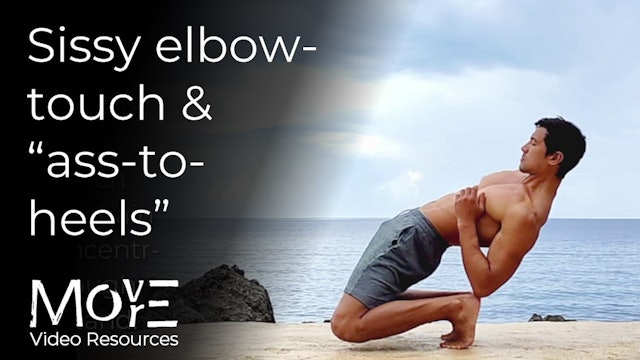
Sissy elbow-touch & Sissy "ass-to-heels'
THE WHAT:
Measurable contexts for linearly-progressive 'Sissy-squat' development. Once particular consideration to keep at the forefront in the process of practice is that these forms are not solely capacity-dependent.Rather, as we venture deeper into the potential of what is available regardin...
-
XHT shapes 2 (floating table-supports)
THE WHAT & HOW:
These “floating” XHT variations develop a secondary layer of referent configuration work, where one foot is elevated (chair/bench/partner support at roughly shoulder height) while the system is organised through a single supported base. The structure remains ipsilateral in setup, ... -
Explosive hip-thrust (XHT) synergies
THE WHAT:
The explosive hip-thrust (XHT) is a fundamental synergy underlying many ground-acrobatic forms that require vertical hip projection. It builds directly on the referent configurations (zero-point shapes) developed in the isometric table-hold work: https://youtu.be/3-gk48EgABYResource c...
-
'Table-top' isometric variations
THE WHAT:
A fundamental straight-arm shoulder-extension context for mobility, strength, and structural-balance development (i.e. to "balance out" overhead pushing/shoulder-flexion contexts).Whilst the fundamental bilateral context (i.e. both hands & feet on the ground) helps to diagnose, develo...
-
'Explosive hip-thrust' / XHT shapes 1 (Table-holds)
THE WHAT:
Building referent configurations (zero-points) as stable structural shapes from which movement synergies for the explosive hip-thrust (XHT) are organised and expressed. These are developed through progressive table-hold variations, including ipsilateral and contralateral positions, as w... -
'Reverse-hinge' shapes
THE WHAT:
The ‘reverse-hinge’ is a fundamental shape expressed when entering the floor through a backward-reaching trajectory. This type of entrance appears across a range of ground-acrobatic forms and transitional patterns, and depending on the context may be expressed as bilateral, contralatera... -
'Back-switch' variations
THE WHAT:
The 'back-switch' is a basic arm transition which switches from side-to-side through a reverse-support position. It is ultimately plugged into floor-communication sequences as a transition which takes the body from a quadrupedally prone position (belly facing floor) through supine and b...