Breathing-forms
‘Breathing forms’ create a space for the cultivation of somatic awareness, allowing the practitioner to explore, in an embodied way, the intrinsic relationship between breath and movement. Every breath elicits a natural wave through the body, transmitting through the spine and into the extremities. Whether consciously directed or not, breathing is inseparable from movement - even at rest, subtle oscillations and internal rhythms continue to ripple through the system, reflecting the body’s constant state of dynamic activity.
Within this collection, the practitioner learns to coordinate breath with movement, not by forcing breath to fit an external structure, but by allowing movement to be guided and informed by the breath itself. Forms such as ‘Teacups’ and ‘Spinal-pumping’ emphasise moving with the breath, rather than breathing to match the movement - a subtle but fundamental distinction that shifts the practice toward internal regulation and responsiveness.
These extended, rhythmical breathing patterns promote nervous system coherence, supporting a balanced interplay between sympathetic and parasympathetic activity. Through this, the practitioner develops a more stable and adaptable internal state, alongside a deeper sense of full-body respiratory integration, where breathing is no longer localised to the chest or abdomen, but experienced as a whole-body phenomenon.
Other forms, such as breathing “Chest opening”, ‘The Da Vinci’, and contexts like hanging with “breathing into the lumbar spine”, explore the manipulation of internal pressure systems. Through the coordinated action of the diaphragm and surrounding musculature, these patterns create a distinctive internal stretch, expanding tissues from the inside out and supporting mobility, elasticity, and space within the body.
In addition to their physiological effects, ‘breathing forms’ function as observation contexts. They provide a consistent, repeatable framework through which the practitioner can tune into subtle changes in tension, rhythm, mobility, and overall state. In this sense, they act as a daily reference point, allowing ongoing reflection on questions such as how the body feels, how freely it moves, and how effectively it coordinates breath and structure.
Functionally, these patterns are non-linear and timeless. They do not follow a progression model or serve as a stepping stone toward more complex skills. Instead, they remain constant throughout the practice, offering both immediate and long-term benefits. As such, they form a reliable foundation for self-regulation, recovery, and internal awareness, complementing and supporting all other areas of movement practice.

-
The 'Teacups' (medial & lateral)
THE WHAT & HOW:
A timeless context expressing a timeless pattern - mechanically, the 'Teacups' are a figure-8/"infinity" drawn in bilateral synchronicity with the arms. They pass overhead and underneath in both directions ('medial', initiating PROXIMALLY from the CENTRE of the body and transmitti... -
IN FOCUS: 'Teacups'
THE WHAT:
Taking an 'In Focus' look at an ancient & fundamental arm-pattern, the 'Teacups'. This movement can be incorporated indefinitely into daily practice, serving as a 'constant' against which to as how you are feeling and moving at this point in time. A as rhythmical, breathing form, it can... -
Standing 'Hinge & fold' (breathing form)
THE WHAT & HOW:
Whilst primarily a breathing-frame, one which combines controlled inhalation & exhalation with a maximal "hinging" stretch of the lower posterior-chain and “folding” to a seated position on the heels, it also serves as a low-intensity prehabilitation context for the knees in deep ... -
IN FOCUS: 'Hinge & Fold' breathing-form
THE WHAT:
Taking an 'In Focus' look at the 'Hinge & Fold' breathing form. Find the associated resource here: https://www.movemorevrl.com/videos/standing-hinge-foldResource contents:
00:05 - Introduction & on 'breathing-forms'
02:06 - On form, structure & execution
04:45 - On variations in 'fold... -
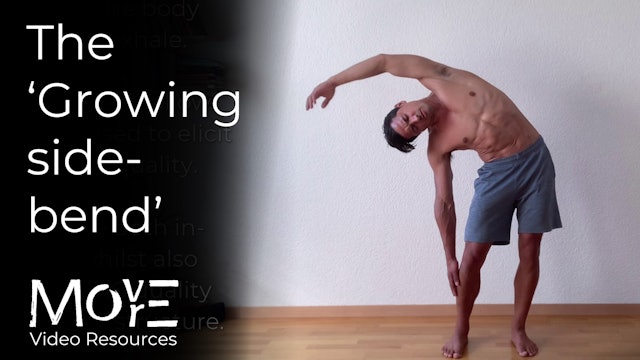
The 'Growing side-bend'
THE WHAT
The 'Growing side-bend' or "breathe & grow" is a specific breathing form which expresses the length of the body's lateral-lines. Effectively a LOADED stretch utilising the weight of the head and overhead arm, it affects not only the spine in the frontal-plane but also the rib-cage, hips,... -
Breathing "Chest-opening"
THE WHAT:
A breathing form as an "antidote" to kyphotic lifestyles. This context presents different variations based on the same fundamental concepts: using a back-bending & arm-extended form to "open" the chest-region, then using an inhalation to "expand" and exhalation to "compress" in order to... -
IN FOCUS: Breathing "chest-opening"
THE WHAT:
Taking an 'In-focus' look at a breathing form as an "antidote" to kyphotic lifestyles. This context presents different variations based on the same fundamental concepts: using a back-bending & arm-extended form to "open" the chest-region, then using an inhalation to "expand" and exhalat... -
The 'Da Vinci' form
THE WHAT:
The 'Da Vinci' is a spinal-mobilisation & breathing form which takes its name from Da Vinci's Vitruvian Man. In practice, it is a wave-transmission form - consistently undulating from the soles of the feet and transmitting out through the palms of the hands - combined with incrementally... -
IN FOCUS: The 'Da Vinci'
THE WHAT:
Taking an 'In Focus' look at the 'Da Vinci', a spinal-mobilisation & breathing form which takes its name from Da Vinci's Vitruvian Man. In practice, it is a wave-transmission form - consistently undulating from the soles of the feet and transmitting out through the palms of the hands - ...