'Emptying' & tension-modulation
This collection develops the ability to regulate, reduce, and manage baseline muscular tone through active release practices, primarily using shaking, tremoring, weight release, and oscillatory movement patterns. It functions as both a recovery method and a coordinative training context, where the body is regularly brought back toward a more neutral state after exposure to increasing levels of physical and neurological load.
It also operates as a baseline calibration layer for all other movement practices, ensuring that accumulated tone from training does not become the default resting state of the system, but remains continuously adjustable.
At the core of this work is the practice of ‘emptying’, understood as the deliberate process of releasing unnecessary or accumulated tension from the system. Rather than passive relaxation, this is an active modulation of tone, where the practitioner learns to identify where holding patterns have formed and allow them to discharge through structured movement. In this sense, ‘emptying’ is not an occasional intervention, but a recurring practice embedded throughout training and daily life.
A key function of this collection is its role as a continuous somatic feedback tool. By repeatedly engaging in these practices, the practitioner becomes more sensitive to subtle changes in muscular tone, often noticing tension that would otherwise remain unnoticed. This builds an ongoing awareness of how the body accumulates load over time, and when intervention is required. In this way, the practice refines the ability to observe, track, and respond to internal states of tension in real time.
Over time, this also develops a clearer distinction between productive tone and residual holding, allowing the practitioner to maintain necessary activation for movement while avoiding unnecessary background contraction.
From a coordinative perspective, ‘Emptying & tension modulation’ develops differentiation under dynamic conditions, meaning the ability to selectively release certain muscle groups while maintaining necessary activation elsewhere. Shaking and tremoring are not random outputs, but organised coordinations of contraction and relaxation, requiring control over timing, rhythm, and distribution of effort across the system. This makes the practice simultaneously therapeutic and skill-based, sharpening movement intelligence through controlled release.
Importantly, this work also supports nervous system regulation, providing a structured context for shifting between higher and lower states of arousal. Through repeated practice, the practitioner develops the ability to downshift after intense activity, restoring composure, responsiveness, and structural efficiency. This makes the practice especially relevant both between sessions and during daily life, not only as a formal sequence but as an ongoing tool for maintaining system balance.
Underlying all of this is the principle that movement control is built on the relationship between contraction and relaxation. By refining both the ability to generate tone and the ability to release it, the practitioner develops greater mastery over how the body organises force, structure, and responsiveness. Over time, this leads to improved elasticity, reduced unnecessary holding, and a more adaptable baseline state for all other movement practices.
In this sense, ‘emptying’ is not separate from training, but integral to sustaining training capacity itself, ensuring that increased performance does not come at the cost of accumulated rigidity or reduced sensory clarity.

-
3-5 min weight shift emptying
An further context for tension-modulation, extending from concepts practiced in the foundational ‘3–5 mins emptying sequence’: https://www.movemorevrl.com/videos/3-5-mins-emptying-sequence
In this variation, the principle of weight-dropping is combined with structured weight-shifting between foo...
-
3-5 min 'wilting-plant' emptying
THE WHAT:
An ‘emptying’ sequence which applies understanding of the fundamental concept of shaking, tremoring & ‘weight-dropping’ develop in the ‘3–5 mins emptying sequence’: https://www.movemorevrl.com/videos/3-5-mins-emptying-sequence. Where desired, the ‘Kidney-taps’ at their 3-levels of inten... -
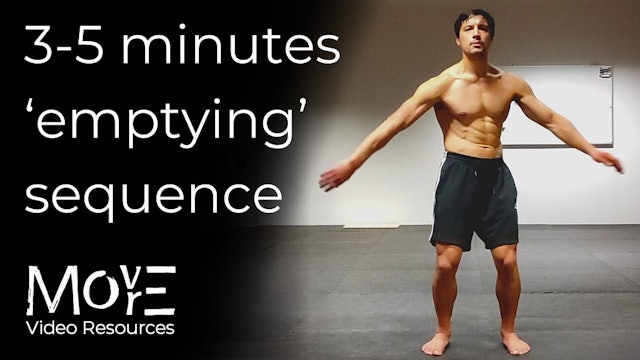
3-5 mins emptying sequence
THE WHAT:
The practice of 'emptying' is essentially one of locating and releasing unwanted tension in the body. It is grounded in a perspective that whilst tension in its many forms grows like weeds in a garden (a result of our general living conditions and habitual practices), the "weeding", or ... -
Gerneral Shaking Concepts
THE WHAT:
Shaking is the natural way to release tension and return the body to its normal homeostasis. It is a primal impulse to a stressful situation. Animals naturally shake to release tension after a life-threatening event. Shaking activates the parasympathetic nervous system and signals the b...