Upper-body elasticity
Upper body elasticity focuses on developing the ability of the arms, shoulders, chest, and upper kinetic chain to absorb, store, and re-express force through the stretch-shortening cycle, while maintaining shoulder integrity and efficient force transmission through the upper system. The emphasis is on creating smooth elastic behaviour in both free-moving and supported upper-body actions.
This includes open kinetic-chain expressions, such as arm swings and circular arm actions, where the limbs move freely through space and must negotiate centrifugal forces. These contexts require the practitioner to reduce unnecessary muscular tension so the arms can function more like elastic transmission structures, allowing force to travel through the shoulder complex without interruption. This quality directly supports activities such as throwing, striking, punching, and other ballistic upper-limb actions where relaxed efficiency is essential for speed and power.
It also includes closed kinetic-chain expressions, where the hands interact with the ground in pushing and supporting actions. Here, elasticity is expressed through the ability to absorb load through the shoulders and chest and re-express it dynamically, such as in bouncing support positions or elastic push-based transitions. While less commonly trained, this capacity is important for developing resilient shoulder function and responsive upper-body strength.
At a coordinative level, upper body elasticity depends on the ability to regulate tension, timing, and structural organisation across the shoulder girdle and trunk, ensuring that force is neither lost nor overly rigid. The system must learn when to release, when to stabilise, and how to transition smoothly between absorption and propulsion.
Across athletic and acrobatic contexts, this quality supports more efficient throwing mechanics, striking speed, landing resilience through the arms, and fluid transitions in ground-based movement. It contributes to healthier shoulder function by encouraging adaptable loading rather than rigid or isolated effort patterns.
Over time, upper body elasticity develops a system that is more responsive, supple, and capable of transmitting force through the arms and shoulders without interruption, allowing for both control and explosiveness within the same movement structures.

-
'Caterpillar' bounces
THE WHAT:
The ‘Bouncing Caterpillar’ is an elastic upper-body context centred on developing the stretch-shortening cycle (SSC) through the arms and chest in a closed kinetic-chain position. While the chest contributes significantly, the arms are the primary limiting factor, making this an effecti... -
Stepping + arm-coordination & 'FG&T'
THE WHAT:
A fundmental context of practice to develop both a conceptual & applied understanding of 'force-generation & transmission' ('FG&T'). It is expressed in the execution of basic arm-swing coordinations, a practice also to itself, now with the addition of "organic" stepping (i.e., the basic... -
Arm-coordination & force-generation
THE WHAT:
A fundmental context of practice to develop both a conceptual & applied understanding of 'force-generation & transmission' ('FG&T'). It is expressed in the execution of basic arm-swing coordinations, a practice also to itself, whilst of utmost importance ensuring at all times that the a... -
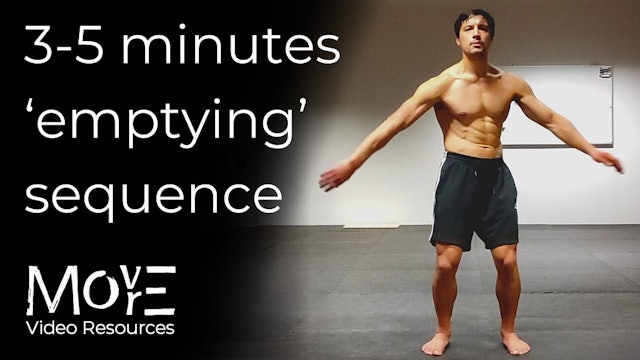
3-5 mins emptying sequence
THE WHAT:
The practice of 'emptying' is essentially one of locating and releasing unwanted tension in the body. It is grounded in a perspective that whilst tension in its many forms grows like weeds in a garden (a result of our general living conditions and habitual practices), the "weeding", or ...